
1-Clear the Graveyard
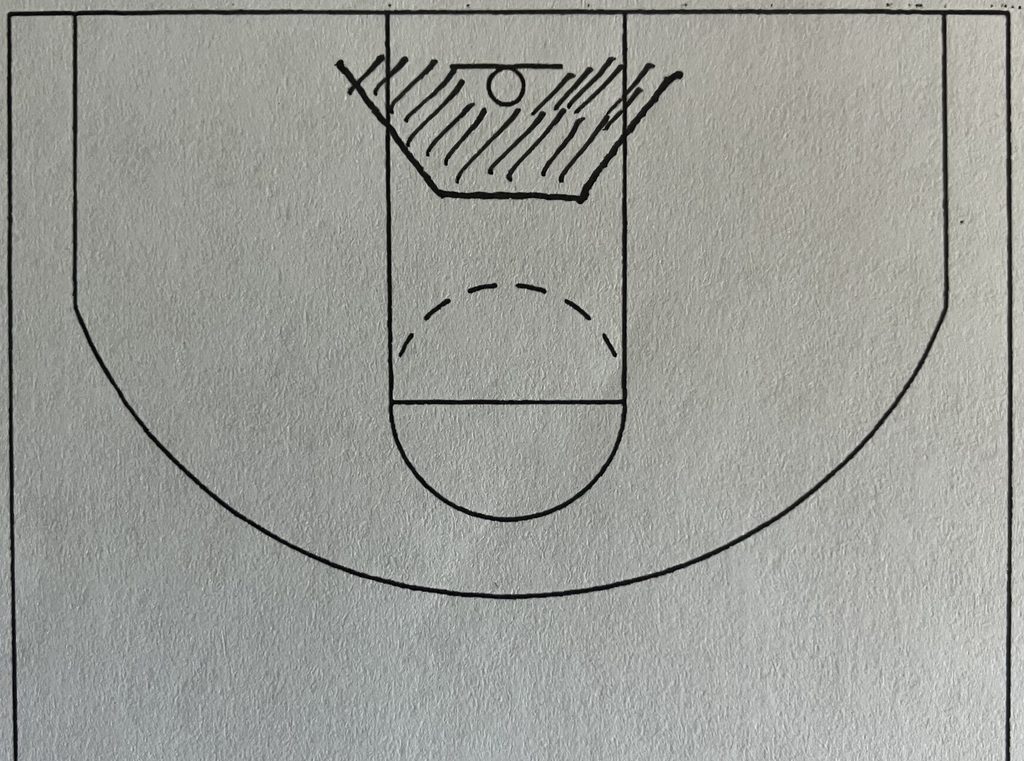
The “Graveyard” is a term I use to describe the area around the basket. The top of the Graveyard goes across the lane at about the midpost. It stops on either side of the lane with about a foot to half a foot still inside the lane. From this point in the lane it goes down at about a 45 degree angle to the baseline. This angle down to the baseline has the Graveyard cutting right through the topside of the block on both sides. This area is the Graveyard.
The Graveyard has to be clear for good rebounding. If a defender is boxing out but are within the Graveyard, then there is a high probability that the ball will bounce over their head and back to the offense. I want a good box out but it has to be far enough away from the basket so the ball does not bounce over their head.
The Graveyard is a simple and easy way for the players to understand the area needed to be clear so the defense has the best chance of getting a rebound. To clearly make this point, I even will put tape down on the court to give the players the exact visual area of the Graveyard. This makes it very clear on whether or not the defender is doing it correctly. If they are in the Graveyard, then they need to get farther away from the basket on their box out. Every player can look down at everybody’s feet and determine whether they are far enough away from the basket or not.
The Graveyard must be clear. This gives the defense an area around the basket empty of any offensive player. If the offense is outside of the Graveyard, then the only chance of them getting a rebound is if the ball hits the rim just right and produces a very long rebound. Otherwise, the ball will bounce within the Graveyard. If the defense maintains their box outs outside of the Graveyard, then they will be able to get the rebound without any interference from the offense.
2-Win the Point of Contact
Everytime a box out occurs there is a collision between the offensive and defensive player. The moment of the initial collision between the two players is what I am referring to as the point of contact. The winner of the point of contact is going to gain the better position way more often. By winning the point of contact the player is gaining positional advantage against their opponent.
As a defensive player, winning the point of contact helps to stop and move the offensive player back away from the basket. This helps to keep the Graveyard clean. The defensive player can stop the offensive player which eliminates any momentum the offensive player could have in trying to get an offensive rebound.
As an offensive player, winning the point of contact helps to drive the defender back under the basket. Defensive players that are under the basket are not going to be able to rebound well. The offensive player winning the point of contact helps to push the defender under the basket which leaves the offensive player more area where they can get the rebound.
A lot of coaches talk about boxing out but winning the point of contact is way more important in my opinion. Rebounds are happening so fast that a true standard box out is hard to get. A defensive player that loses the point of contact can still have a great box out but it does not matter because they are so far under the basket that they are unable to get a rebound. On the other hand, a player can win the point of contact and have no box out but still get a lot of rebounds because they have stopped and moved the offensive player away from the basket.
The point of contact is so important because it helps to establish the line between the offense and defense. The farther away from the basket the defense can move that line the better. Any rebound landing within that line will be much easier for the defense to get. Likewise if the offense can drive the defense to the basket, then rebounds are going to come over the line which gives the advantage to the offense. The point of contact needs to be stressed way more than just a normal box out.
3-Release and Go Get the Ball
The final key is to release and go get the ball. If the defenders are able to keep the Graveyard empty and win the contact point, then they have created some space between themselves and the basket. This is good because the more empty space around the basket, the more likely the defense will get the rebound. So, the final key is to release the box out and go get the ball.
A defensive possession is not over until the defense has the ball. The defense can do everything right but if the offense is able to get offensive rebounds then the possession was a failure. The rebound is the final piece of every defensive possession. There has to be a mentality for each defender of wanting to control the ball to end the possession.
The easy way to do this is to attack the rebound once the position is secured. I want to create space around the basket. I want to win the point of contact to stop the offensive players and push them even farther away from the basket. But in the end the ball is the key. A defensive player can get stuck too far under the basket by losing the point of contact but if they are still able to get the rebound, then they have still ended the possession even though they did almost everything wrong.
The first two keys help a player to get a rebound. But the player possessing the ball at the end of the rebound determines who won and who lost. The players have to be in the mindset of securing their box outs but they then have to go get the ball. There needs to be an aggression in going after the ball. The players have to attack the ball and go win each rebound. There is not some magical solution to rebounding. It boils down to every player going and getting the ball with almost reckless abandon. This can hide some mistakes with the 1st two keys but this last key is the most important because it determines who gains possession over the ball.