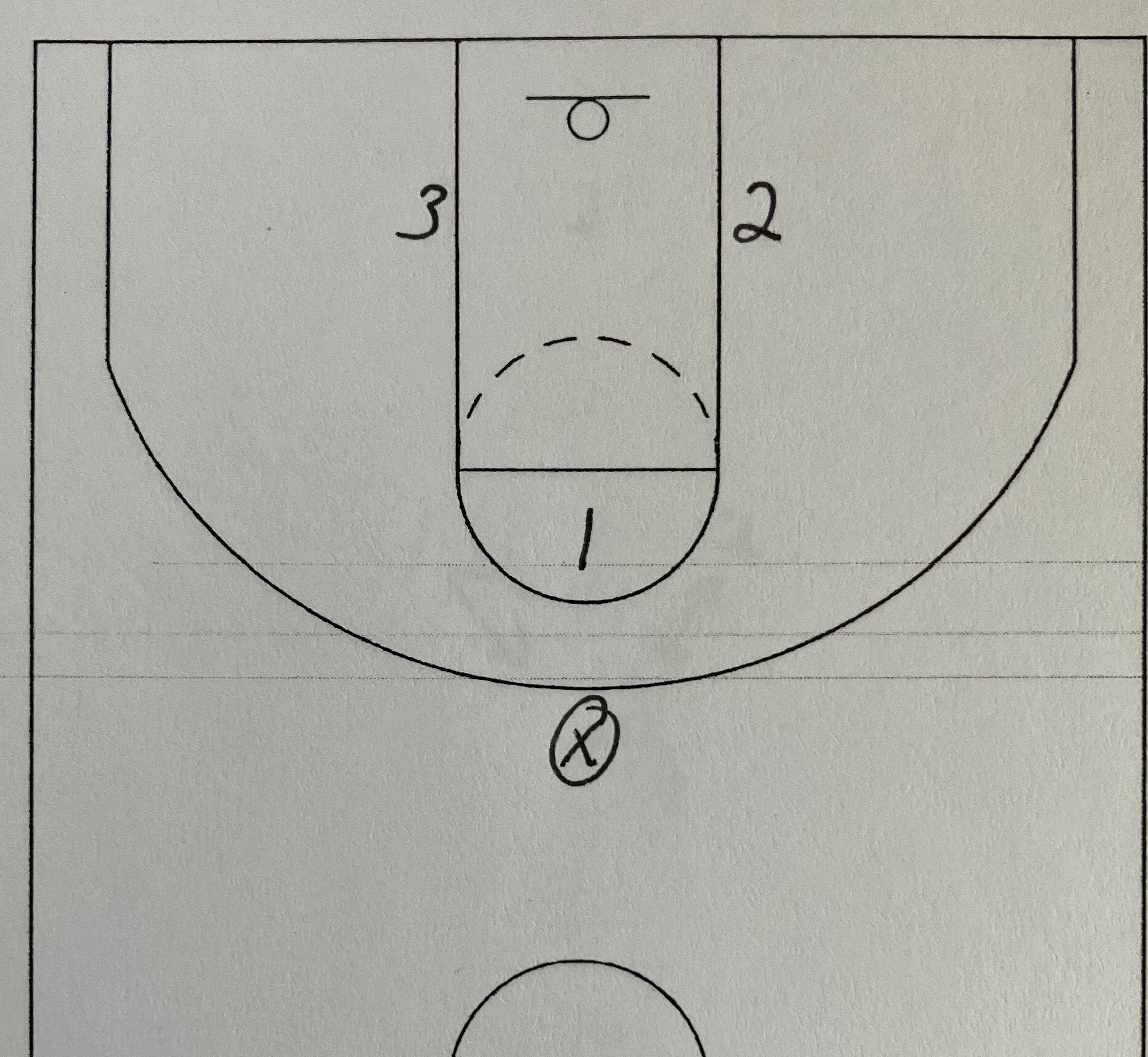
What is a 3-2 Zone Defense?
A 3-2 zone defense is a defense with 3 players across the top of the zone and 2 players on the bottom. The 2 bottom players will start on each block. The middle player in the 3 across will be right at the top of the key on the 3-point line. And the 2 wings are going to be extended out closer to the wings of the offense.
The point man or middle man of the 3-2 zone is going to follow the ball and stay in between the ball and the basket. They will stay almost on the lane lines as they go around the floor following the ball. This player is the most important player in the 3-2 zone. They have to be able to guard the opponent’s guard when they are at the top of the key. They also must be able to guard the opponent’s post players when they are on the block.
With the point defender rotating around the entire floor, the other players do not have to rotate as much. The post players are going to be staying on their side the majority of the time in the zone. This means the post players can be slow and still be effective within the zone defense. It also means the post players of the zone are going to be on the backside of the zone for rebounding.
The wings are also going to stay on the outside more often. They will have to rotate to the high post when they are on the backside, but they will never have to drop down to the block. This keeps the post players near the basket and the wings on the outside of the defense except for the point defender who will be covering both.
What is a Box-1 or Diamond-1 Defense?
A box-1 or diamond-1 defense is a combination defense using some man-to-man defense as well as some zone defense together. This is a defense mostly used against teams who have 1 really good offensive player or scorer and 4 mediocre or bad offensive players. This gives the defense the ability to focus all their attention on stopping one offensive player.
In a box-1 or diamond-1 defense one defender is going to be playing man defense against one offensive player. The other four defenders are going to be playing zone in either a box formation or a diamond formation depending on what each team decides to play.
A box formation has a defender on each elbow and block. Each defender is guarding their zone around them with the two elbow players guarding essentially the top and wings and the two block defenders guarding the paint and baseline out to the corners.
A diamond formation is when one defender is at the top of the key. Two defenders are mid-post to elbow. And one defender is in the middle of the paint in front of the rim. A diamond gives the defense the ability to put more pressure on the ball up front and better rim protection in the lane.
In either formation, the combination defense gives the defense some man-to-man principals and some zone principals. The defense has to have at least one good on the ball defender and the offense has to have one player substantially better than their teammates. The hope is to have help all over the floor for the best offensive player while playing in a zone defense against the other 4 offensive players.
Best Team Personnel for a 3-2 Zone Defense
The key to the 3-2 zone starts with the point man at the top of the zone. This player has to be able to guard the perimeter and the block. They have to be able to defend quick guards as well as post players. Without this one player, the 3-2 zone is not going to work. A quick stretch 4 or a tall guard are ideal for this spot.
The next personnel for the 3-2 zone is usually a team with 2 bigs on the court at the same time. The bigs are usually slower players. The 3-2 zone helps to limit the movement of the 2 bigs on the block. The 3-2 zone helps to maximize the advantage of having two bigs on the floor at the same time. It also helps to reduce the disadvantages of having two slower players on the floor at the same time.
The two wings can be any type of player. The taller these wings are the better, but they are going to be staying on the outside, so they do not have to be tall.
Best Team Personnel for a Box-1 or Diamond-1 Defense
The best team personnel for a box-1 or diamond-1 defense is having at least 1 really good defensive player. When a team decides to use a box-1 it is normally because of a really good offensive player on the opposing team. This means a team is going to all out deny that player the ball knowing the other 4 defenders are in positions to help if the man defender gets beat.
This means the one good defensive player needs to be in good physical shape to chase the offensive player. They need to be quick to react to the offensive player to maintain a denial position to prevent the offensive player from getting a pass. And they need to be able to guard the ball well if the offensive player is able to get the ball.
The best defender is tasked with trying to prevent the offensive player from getting the ball. The other 4 defenders are going to be playing in a zone behind the lone man-to-man defender. These 4 zone players must keep good communication but there are no physical traits needed for these 4 defenders.
When to Use a 3-2 Zone Defense?
The 3-2 zone is a zone defense that is more aggressive than the 2-3 zone but not as aggressive as the 1-3-1 zone defense. It gives the defense the ability to pressure the ball on the perimeter while maintaining a good presence around the basket.
It is a good defense to add along with the 2-3 zone or the 1-3-1 zone to give the ability to be more aggressive or more conservative without going to an extreme. It can give a passive defense the ability to become more aggressive. It can give an aggressive defense the ability to become more conservative. It can give the defense a little adjustment to get the offense out of rhythm.
The 3-2 zone is also a good zone to get closeouts on the perimeter. All 5 defenders are responsible for a portion of the 3-point line. This gives the defense the ability to cover more of the perimeter and reduce outside shots. This would be a good zone to use against a team that likes to play a 5-out offense. The 3-2 zone has the ability to spread out and maintain coverage around the perimeter.
When to Use a Box-1 or Diamond-1 Defense?
The box-1 or diamond-1 defense is used mainly in two different situations. The first situation is when the opponent has 1 very good offensive player and the other players on the team are not good offensive threats. This means the entire focus of the defense is on stopping that one player.
The box-1 or diamond-1 defense keeps all the focus on that one player. It gives the defense the ability to double team that player every time they catch the ball while keeping 3 other players in and around the basket. The hope is the double team will help to prevent the best offensive player from shooting and scoring as much during the game.
The 2nd situation is an in-game decision. If a player on the opposing team is having a career night offensively, then the defense can go to a box-1 or diamond-1 to try and disrupt the rhythm of that player. The only problem with this is the coach has to recognize the opposing player is having a very good night scoring. And the defensive team must have prepared the box-1 or diamond-1 defense in practice already.
The box-1 or diamond-1 is a specialty defense so most teams do not practice the defense. If the team has not practiced the defense, then it is unlikely to work. So, in order to use it during a game unexpectedly the team has to have it prepared beforehand. And this is normally not the case for most teams.
Advantages of a 3-2 Zone Defense Over a Box-1 or Diamond-1 Defense
1) Better Middle Protection
The 3-2 Zone Defense is built on keeping outside coverage against a 3-point shooting team while reducing rotations to be able to play multiple post players. The lack of rotations by every defender but 1 keeps guards out front and the bigs down low. The 1 defender constantly rotating is doing so within the lane.
By keeping the middle defender rotating on the lane lines, the 3-2 Zone Defense keeps a continual defender in the middle. This helps to prevent the offense from getting the ball into the interior of the zone. The offense must try and attack the zone from the outside or baseline. Either way the middle of the zone is protected.
The Box-1 or Diamond-1 Defense leaves the middle of the zone open because that middle defender is out guarding the best offensive player man to man. Being a hybrid defense, the Box-1 Defense has to give something up to the offense to play both man and zone. The Box-1 Defense leaves the foul line area open and relies on defenders rotating into the area when needed.
The idea of the Box-1 Defense is the offense is going to struggle to score points as long as the best offensive player is not scoring. So, even if the offense can get the ball inside the zone, they will still struggle to score. The middle of the court is left open to keep better overall spacing in the box formation for the defense.
2) Less Rotations
The 3-2 Zone Defense is a great zone defense for most teams because it is a very simple defense aside from one defender. Four defenders are very limited in their movement while the fifth defender is constantly moving with the ball. The type of rotations makes it very easy for 4 out of the 5 defenders.
The less rotations mean there is less of a chance for a breakdown. Defenders are staying in a very small area so even on a slow rotation, they are still almost in the right defensive position. The lack of rotations gives slower teams a chance to run an effective zone defense without having to chase the ball all over the court.
The Box-1 or Diamond-1 Defense is removing 1 defender from the zone. This creates more open space in the half-court. Each of the 4 zone defenders are now having to cover the area a 5th defender would cover in a non-hybrid zone defense. The 4 zone defenders will be rotating more in a Box-1 or Diamond-1 Defense.
3) Better Outside Coverage
The 3-2 Zone Defense is a great zone defense against a high volume 3-point shooting team. Each defender has an area of the 3-point line to cover. This splits the 3-point line into 5 parts. Each defender has one of those parts. This gives the 3-2 Zone Defense great outside coverage.
The 3-2 Zone Defense uses all 5 defenders to cover the 3-point line whereas most other zone defenses like the 2-3 Zone and the Box-1 Defense use only 4 defenders. The amount of space each defender has to cover is lower when using all 5 defenders instead of just using 4 defenders. By reducing the amount of space each defender has to cover on the 3-point line, the 3-2 Zone Defense is able to have better outside coverage.
The Box-1 Defense and most other zone defenses use only 4 defenders to cover the outside. This leaves 1 defender left in the middle of the zone staying primarily in the lane. This one inside defender helps to guard the middle of the court, be a rim protector, and stay close to the basket for rebounding. Each zone defense using only 4 outside defenders are choosing to have better inside coverage than outside coverage.
The Box-1 Defense does not have this middle defender. It is choosing to leave the middle open in order to keep a defender directly guarding the best offensive player. The thought is the Box-1 Defense will help to prevent the best offensive player scoring. The drawback is the 4 defenders covering the 3-point line and the middle of the zone being left open. But if the defense can reduce the best offensive player’s scoring than it has worked as intended.
Advantages of a Box-1 or Diamond-1 Defense Over a 3-2 Zone Defense
1) Best Defensive Player on Best Offensive Player
The whole concept of a Box-1 Defense is to get the best defender matched up against the best offensive player in a man to man defense while the other 4 defenders play zone. This ensures the best defensive player is always guarding the best offensive player.
The reason for the Box-1 Defense is normally because the opponent only has 1 good offensive player. This makes sure the defense is guarding them with their best defensive player. This guarantees the best offensive player is having to score against the best defensive player every possession.
The other thing a Box-1 Defense can do is to double the best offensive player with 1 of the zone defenders and the man defender every time that player touches the ball. This makes it even harder for them to score. The Box-1 Defense is trying to limit the points the best offensive player can score.
The 3-2 Zone Defense gives the offense a chance to move the best offensive player around to gain a favorable initial matchup against the defense. The offense can choose which defender to single out and focus on. The best offensive player simply moves into their area and waits for the ball to be passed to them. Once they have the ball, they can attack the weakest defender immediately and go right around them to give the offense an advantage.
If the 3-2 Zone Defense has the best defender on the right side of the floor, then I as an opposing coach would constantly move my best offensive player to the left side of the floor. This keeps the best defender from guarding the best offensive player. A zone defense keeps their players in certain spots. An offense can respond to the setup of the zone by putting their players in positions where the offense has a significant advantage in the matchup.
2) More Likely to Confuse Offense
The irregularity of facing a Box-1 Defense can make offenses confused on what to do. The hybrid defense of part man defense and part zone defense gives the Box-1 Defense a chance to confuse the offense. The offense can become unsure on what to do. Do they run a man offense or a zone offense?
Some teams and coaches are never going to see a Box-1 Defense. Some coaches use the Box-1 Defense almost every game. But for the most part, the Box-1 Defense is one of the rarer zone defenses being used. The unfamiliarity of the Box-1 Defense can make offenses struggle.
The offense has to decide whether to run a man offense or a zone offense. Both types of offenses can struggle because the Box-1 Defense is a hybrid using both man and zone. The Box-1 Defense also is guarding the best offensive player in a man to man style. This pushes other offensive players to do more. The Box-1 Defense forces the offense to do things that they do not normally do hence confusion can occur.
The 3-2 Zone Defense can cause confusion if the opponent has not properly prepared for the zone. However, with good scouting the offense should have a gameplan on how they are going to attack the defense. Practice time should have been used to go over what the offense is trying to do against the 3-2 Zone.
The 3-2 Zone Defense can cause confusion if it is the 1st time a team is using the zone defense. Even with good scouting, if the defense has never used the zone before, then the offense has no way of knowing what to do to score against the zone defense.
Even if it is the 1st time a defense is using a 3-2 Zone Defense, the offense should have a couple of zone offenses already prepared to be used. The offense can work with their zone offenses to find one that will work against a 3-2 Zone Defense. The patterned rotations of the 3-2 Zone Defense will eventually be figured out by the opponent and be forced to change.
3) Forces Offense to Use Players Other Than Best Offensive Player
The Box-1 Defense is used when the opponent has their entire offense centered around 1 player. The Box-1 Defense can deny that one player the ball and then double them when they catch it. By focusing all the defensive effort on that one player, the offense will need the other players to create and make shots.
Teams that do not have a good supporting cast of players can struggle to score points if the main offensive player is not scoring. The Box-1 Defense helps to force the offense to use the supporting cast of players and not rely sole on their best player. The Box-1 Defense works to remove the strength of the offense. It works to get the offense to use their 2nd and 3rd scoring options.
The 3-2 Zone Defense works on preventing outside shooting but the offense is never restricted in their ability to use all 5 players. And a good offense will put their best offensive player in the area with the worst defender making their advantage even greater. Put in the right spots, the best offensive player can have an easier time scoring against a 3-2 Zone Defense then they would against other defenses like the Box-1 Defense or Man to Man Defense.
Against a 3-2 Zone Defense, the other 4 players on offense will not be required to score. A team could use the 4 non-scoring players to move and pass and screen for the best offensive player to get them open with the ball. A 3-2 Zone Defense could have the offense rely on their best player even more because they will have the freedom to move without restriction. The role players will be able to take a lesser role on offense then they would against a Box-1 Defense or Man Defense.
Which is Better? A 3-2 Zone Defense or a Box-1 or Diamond-1 Defense
These 2 zone defenses to me are middle of the pack defense when ranking all zone defenses. They both have their good qualities but also but are lacking in certain areas. I would not have either defense be my primary defense. I would have another defense be my primary defense and then use these 2 defenses as counters to certain teams.
Both defenses have major drawbacks. The 3-2 Zone Defense needs to have the right player who can play the point defender position. Not all teams have a player that can guard both inside and outside. The Box-1 Defense needs to be played against a certain type of opponent or the defense will not work. An opponent with multiple scoring options will destroy a Box-1 Defense.
Ultimately, I have to give the advantage to the 3-2 Zone. Given a team that has a player that can play the point position, the 3-2 Zone Defense can be played against every opponent. The Box-1 Defense is dependent on the opponent. Any team that does not have 1 main scorer and only 1 main scorer will be able to beat the Box-1 Defense easily. The Box-1 Defense just is too limited in how often it can be used.