Most teams and offenses are moving into a role less system where players are constantly moving waiting for a player to make an offensive drive and then play off of it. Offenses are free flowing with a few simple rules to keep spacing between teammates. Outside of those few simple rules, the players are free to move and create as they wish.
However, there are times at the high school level and below where the players are just not able to play in free flowing dribble drive system. When the players are not skilled enough to play in a dribble drive system, there needs to be an offense that reduces the amount of dribbling needed to execute the offense. There are a lot of different offenses such as the Bellarmine Offense. This Hi-Post Double UCLA Cut is another.
The offense uses the hi-post as the focal point of the offense with the ball and other 4 players constantly moving around the hi-post. The offense does not need a lot of dribbling nor does it need players to create their own shots. Ball movement, cutting and screens are used to create scoring chances.
This is a great offense when a team has a lack of guards who can handle the basketball well. Once the offense gets going, quick ball movement will keep the defense chasing preventing them from being able to apply good ball pressure. After a few reversals, somebody on offense will find themselves open coming off of a cut. This offense will work but sometimes it takes a little patience until the defense has a breakdown.
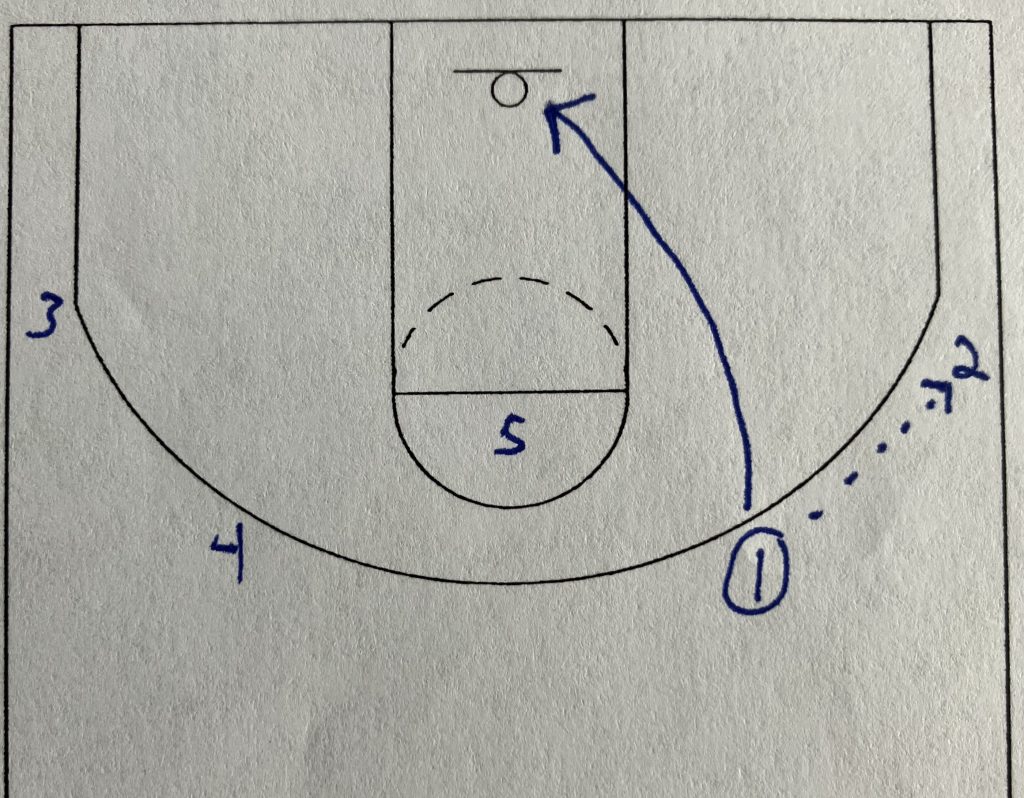
The offense is a 4-out set using the center(5) at the hi-post. The 4-out is set high. The bottom two players on the 4-out need to be on the wings about foul line extended. The top two players on the 4-out are going to be in the slot position angled just outside the elbows.
The top 2 players can be either on the 3-point line or 3-5 feet off of the 3-point line. If they are on the 3-point line, then they are more of a threat to shot. If they are off of the 3-point line, then it can drag the defense farther away from the basket making the screens and cuts easier to get open.
The position of the top 2 players are a team decision. I have used both. When I had good shooters, I kept these two at the 3-point line. When I had quicker players, I wanted them farther away so they had a better chance to use their speed to get open on the cuts.
To start the motion offense, the point(1) passes to the guard(2) and cuts. The offense needs the ball on the wing so the UCLA cuts can occur. The initial pass to get the ball on the wing can be the hardest pass to make. After this pass, the players are all going to be moving keeping the defense from being able to stay in the passing lanes.
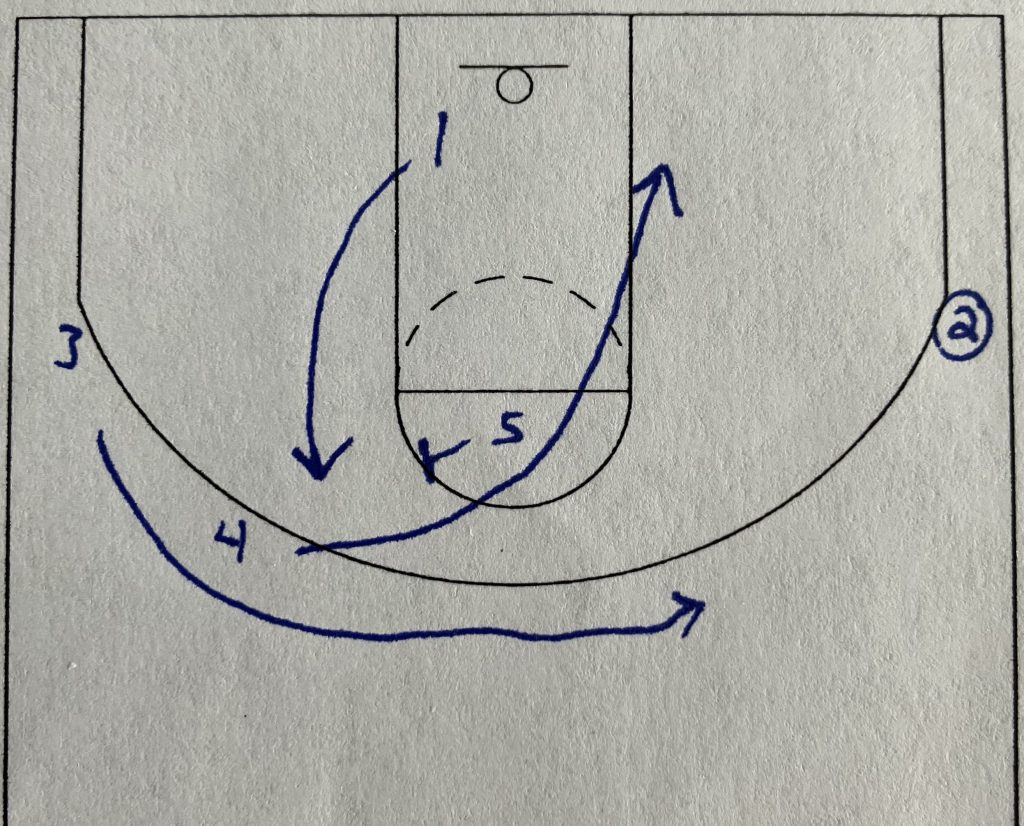
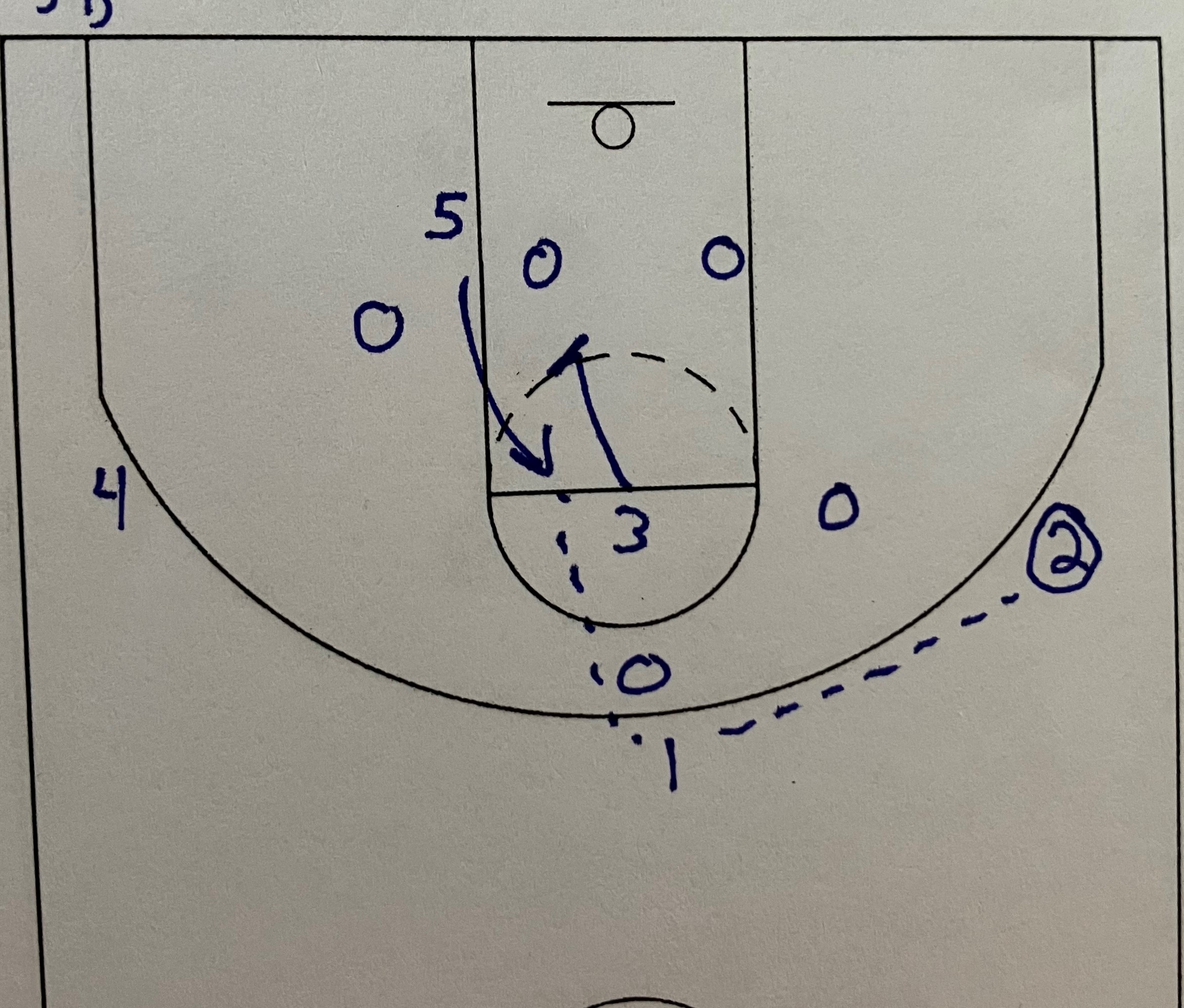
After the point(1) cuts, the center(5) turns and sets a screen for the slot player away from the ball. In the diagram above the center(5) is screening for the big(4). The big(4) is cutting behind the point(1) to the basket. This gives the guard(2) two cutters to pass the ball to for a layup.
The forward(3) is running behind the point(1) and big(4) to fill in the spot. The point(1) after cutting is running up to fill in the next slot position. The big(4) will cut through and fill back in on the backside wing to fill the 3 spots that are left open after the 2 UCLA cuts.
The guard(2) has the ball. The other 3 players are all cutting and filling in. This keeps everybody moving so the defense is going to be chasing the entire time. This makes passing easier because the defense is having to chase and move with the offense.
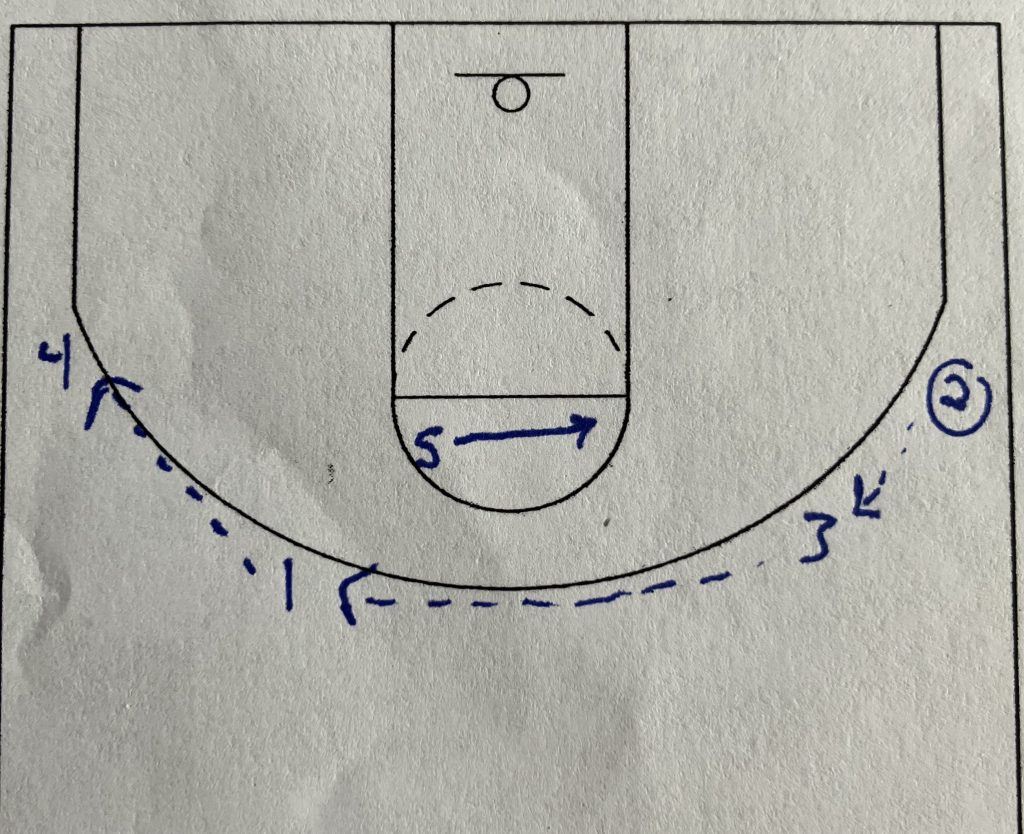
Once the forward(3), point(1) and big(4) fill in the spots, the ball is reversed around the perimeter. The faster the reversal, the less time the defense has to catch up. Again the entire offense is built on getting the ball to the wing so the cutting can take place. With everybody in constant motion, it makes it hard on the defense to get steals.
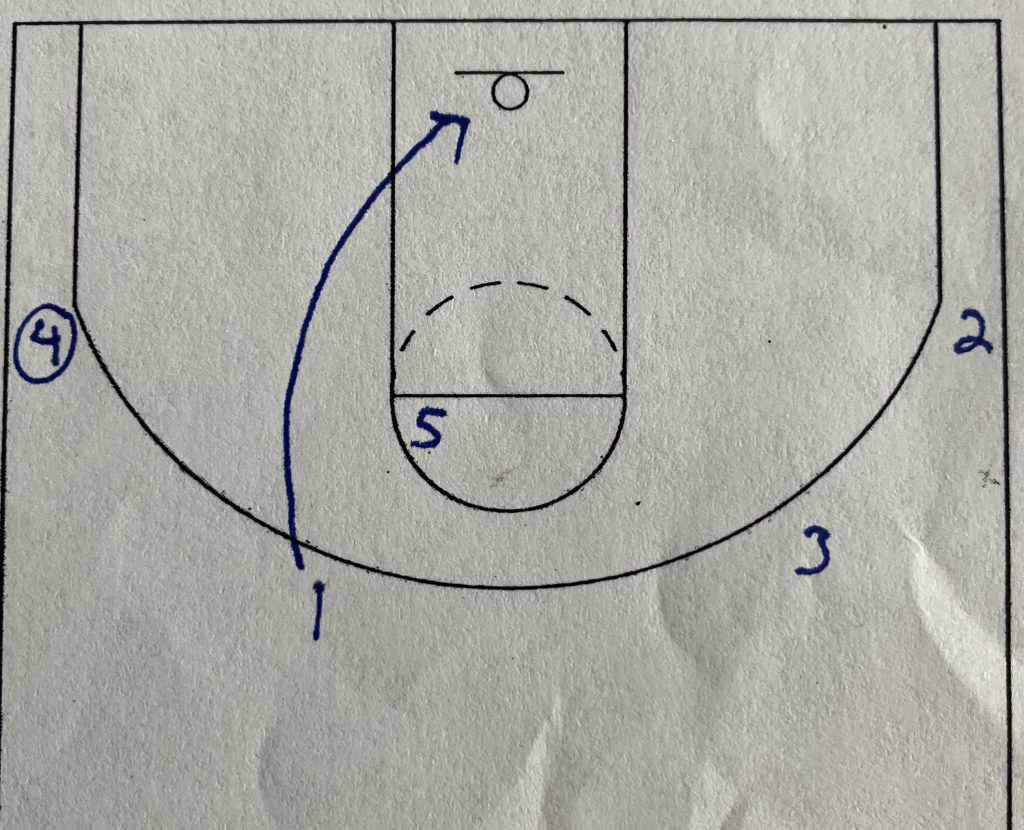
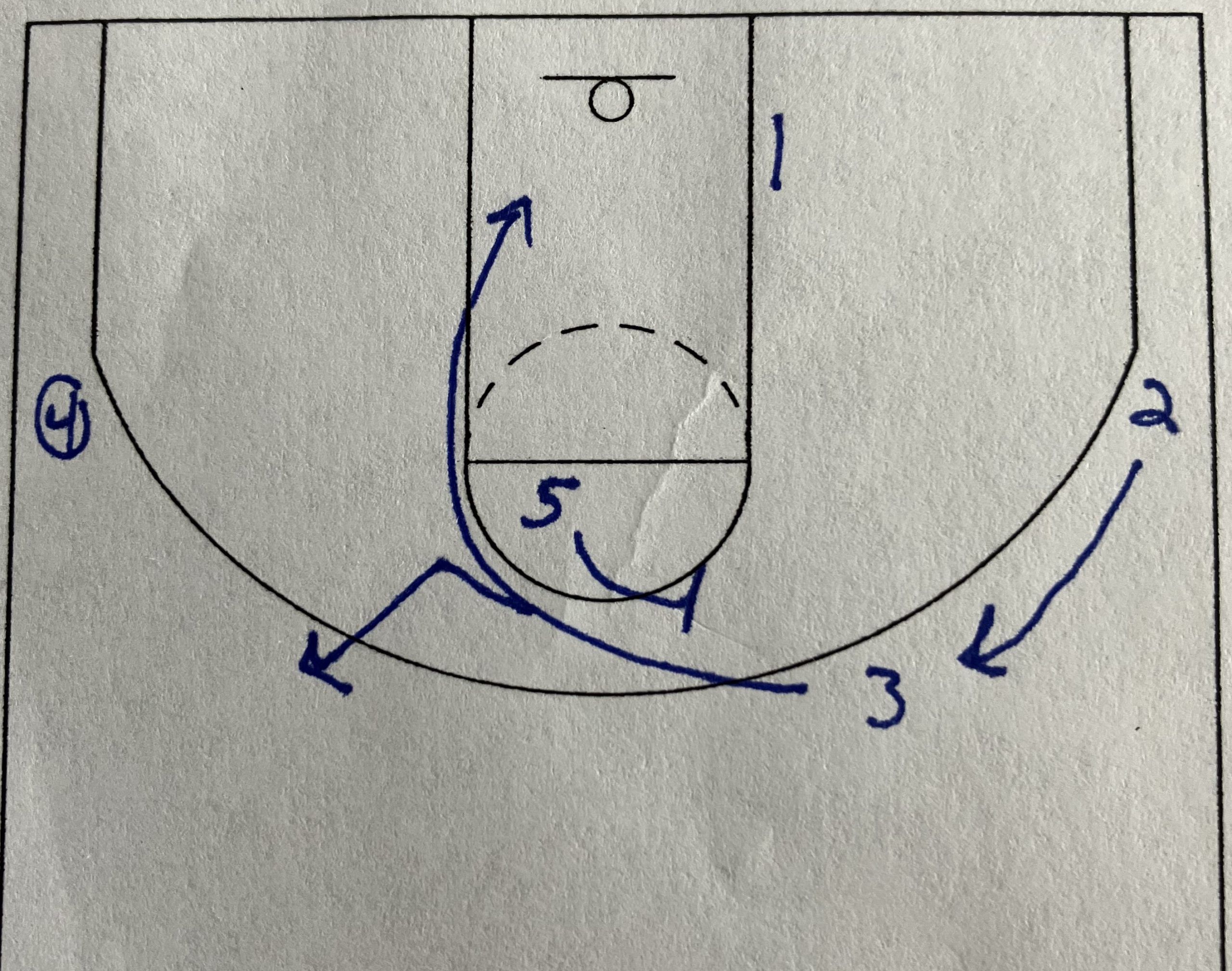
After the ball reversal, the motion offense is just repeating but now going back the other way. The point(1) is cutting after passing the ball to the wing. The center in the hi post is going to turn and screen for the backside slot player. In the diagram above, that is now going to be the forward(3).
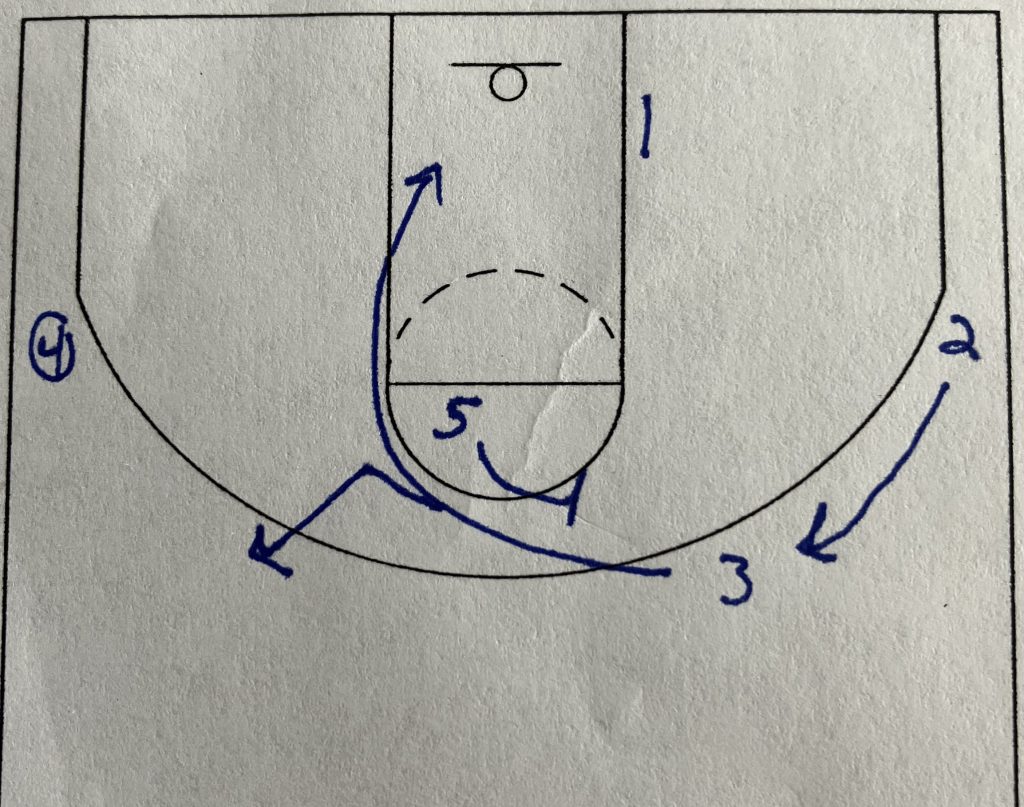
As the forward(3) cuts off of the center(5)’s screen, they have the option to cut through the lane to the basket like before or they can fake the basket cut and step back out to the 3-point line. Once a defense starts to figure out the UCLA basket cuts, a fake basket cut can leave the defense standing in the lane and the offensive player having a wide open 3-point shot. This is just enough of a change where the defense can not get completely comfortable in guarding the motion offense.
The guard(2) is filling in the next available spot. If the forward(3) cuts to the basket, then the guard(2) would fill the left slot position. If the forward(3) does not cut, then the guard(2) will fill in the right slot position. The point(1) is following and filling in the next available spot whether that be the wing if the forward(3) does not cut or the right slot position if they do.
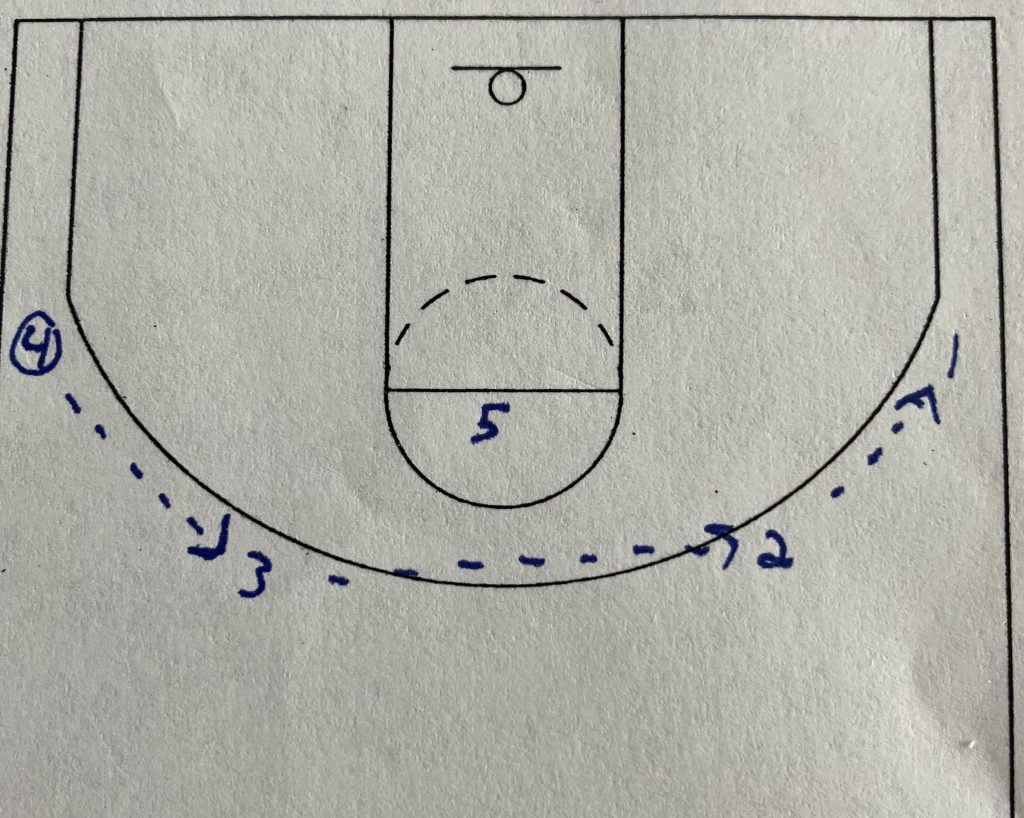
After the one or two UCLA cuts, the ball will reverse again and the motion offense repeats. This offense can keep repeating until a good shot is open. The good shots are very likely to be layups or shots close to the basket.
This is a great play that does not require dribbling or players having to create their own shots. The movement and cutting of the offense works to get the defense out of position. Once the defense gets out of position or gets behind an offensive player, the offense is able to get an open cut to the basket.
The repeating pattern is simple enough for every team to be able to execute the offense. But it has just enough variation with the one or two cutters that the defense will not be able to overplay the motion offense. As soon as the defense overplays the 2 cutters, the 2nd cutter can fake and cut back out to the 3-point line for an open shot.
As the players progress, the different cuts off of the hi-post screen can be introduced to give the offense even more ability to attack the defense no matter how they are playing. There are 4 different types of off the ball cuts using a screen that the offense can read and react to their defender giving each player the chance to get open with every cut.
This is a good offense when a team lacks good ball handlers. But it can also be used with a team wanting an offense to slow the game down. This will spread out the defense and force them to guard in space. It is a constant moving offense that with some additional freedom gives the offense the chance to attack the defense in multiple ways.