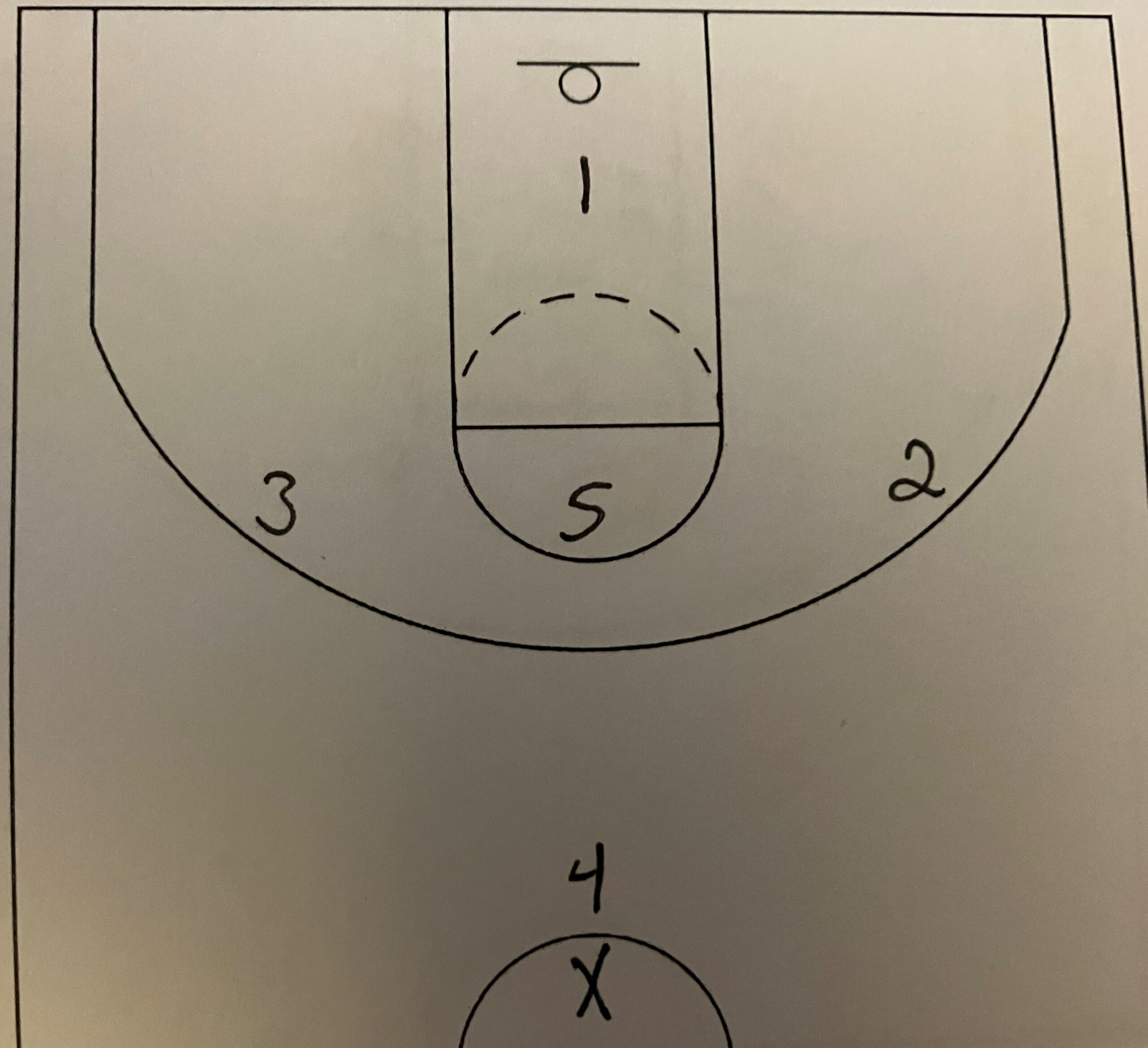
What is a 1-3-1 Press?
A 1-3-1 Press is an extension of the 1-3-1 half-court zone defense. The 1-3-1 press extends the defense usually out to 3/4 of the court. Since it is an extension, the defense is able to press and then drop straight back into a 1-3-1 half court defense. The defensive responsibilities of the half-court defense are basically the same as the 1-3-1 press. This helps players because they are doing the same things but just covering more of the floor.
The 1-3-1 Press tries to get the ball to the sideline to trap with the point and wing right after the ball crosses the half-court line. The 1-3-1 Press is looking to trap in the two corners by the half-court line where the offense is at the biggest disadvantage. The press also keeps a player in the middle of the court to prevent any middle passes from being made.
It is an aggressive press by having 4 players up past half-court to start the press. This leaves long over the top passes and diagonal passes as the hardest passes to defend. When using the 1-3-1 press, the defense is looking to get deflections and steals. It is a good press to use when behind and needing to get back into the game.
What is a 2-3 Tandem Press?
A 2-3 Tandem Press is an extended 2-3 Zone. This gives the 2-3 Tandem Press the ability to extend up the floor while being able to drop back straight into a 2-3 Zone. This helps to prevent baskets in the transition from a press to a half-court zone defense while keeping the players in the same positions for the 2-3 Zone.
The front 2 players in a 2-3 Tandem Press are working together to create the pressure out of the press. One player is extending up to pressure the ball while the 2nd front player is staying in the middle of the floor. The two players on the back line on the outside are coming up to help provide trapping opportunities.
On the initial setup of the 2-3 Tandem Press, it is going to look similar to a 1-3-1 Press. The difference is the traditional middle player who is normally the center in a 1-3-1 Press is going to be at the back of the 2-3 Tandem Press. This gives the 2-3 Tandem Press a much easier time dropping back into a 2-3 Zone.
The front guard is chasing the ball trying to get the ball to the sideline. Once the ball is on the sideline, the two back wings are waiting to try and trap the ball with the front player as soon as the ball crosses half-court.
The idea of the 2-3 Tandem Press is keeping the setup and formation of a 2-3 Zone while being able to extend up the floor to create pressure in a press. It is not going to create as many steals as some other presses but it is not going to give up easy scoring chances in the transition from a press to a half-court 2-3 Zone Defense.
Best Team Personnel for a 1-3-1 Press
The team personnel for a 1-3-1 Press is the same personnel as the 1-3-1 half court zone defense. The keys to the press and half-court defense to work are the same for the 1-3-1 zone. That is why a team that runs a 1-3-1 half-court zone would be wise to have the 1-3-1 press as their first press installed.
The front player in the press needs to be going 1000 miles per hour. They can never stop. This player is going to get tired. They are chasing the ball sideline to sideline. They are trying to keep it from reversing as much as possible. The taller the front player is, the better. But they need to be moving and chasing at all times. The key is they have to be in the right spot for the trap when the wing comes up. That is the biggest job of the front player.
The wings need to be long and athletic. Short wings are going to allow teams to throw over the trap. They also need to be smart. They are the players initiating the trap. They have to rush at the right time or the press will not work. These two wing players are the key to the 1-3-1 press. The wings have to be long, athletic, and smart.
The back player needs to be fast and anticipate well. The back player has to get to every over the top or diagonal pass. The 1-3-1 press is aggressive meaning the long passes could be open. The fast back player is the key to preventing those long passes over the top. They also need to anticipate the wings rushing the ball for the trap. They need to move with the wings to prevent the sideline pass before the trap is there. This is going to be the fastest player on the team.
Best Team Personnel for a 2-3 Tandem Press
The 2-3 Tandem Press is an extension of the 2-3 Zone. This gives the half-court 2-3 Zone the ability to extend the floor defensively. The best personnel for the 2-3 Tandem Press is any defense that is going to use the 2-3 Zone.
The 2-3 Zone is best used with a bigger guy in the middle of the zone and two longer players playing on the sides of the back row. This means the best personnel for the 2-3 Tandem Press is with taller, longer players on the sides of the back row. These two players are going to be involved in any traps so having taller players is going to help those traps.
The other player needed is the front player in the 2-3 Tandem Press. The two guards are going to be stacked. The front player in the stack is going to be chasing the ball no matter where it goes. A guard who is fast helps to provide the initial pressure and funnel the ball into the trap areas. This front player is going to be doing the majority of the running so having multiple players who can rotate in and out of the game is a benefit.
For me, I like to have a guard who I want to stay in the game playing the back position in the guard stack. This can help to conserve their energy in the press. So, if I have a point guard or shooting guard who I want playing the whole game, then they can play the back of the stack. This keeps them from having to run a lot in the press so they will not have to sub out as much.
When to Use the 1-3-1 Press?
The 1-3-1 Press is best used to extend the 1-3-1 half court zone to be more aggressive on defense. This will force the offense to play against the 1-3-1 defense for a longer period of time. This increased time gives the defense more time to get deflections and steals. It is going to help to speed up the offense as well. Offenses that start playing faster than they want too are more likely to turn the ball over.
The 1-3-1 Press is trying to get steals. It is going to be best used to come back when a team is behind and needing extra baskets to get back into the game. It is going to speed up the offense which should lead to more shots taken and more points scored. So, the 1-3-1 Press can help to give the defense more chances at scoring the points necessary to make a comeback.
The 1-3-1 Press can also be used against a team with either short guards or poor ball handling players. The 1-3-1 Press makes passing hard for the offense so short guards will have trouble seeing through the press to know where and when to make a pass. The aggressiveness of the press is also going to cause problems for teams with poor ball handling. The 1-3-1 press makes the guards have to do a little more with the ball and if the opponents are unable to do the extra ball handling, then it could lead to turnovers.
When to Use the 2-3 Tandem Press?
The 2-3 Tandem Press is best used when a half-court 2-3 Zone team is wanting to extend and put pressure up the floor without losing their ability to drop straight back into a 2-3 Zone. The 2-3 Tandem Press keeps the players in the same spots as the half-court 2-3 Zone but just extended up the floor.
The first time I like to use the 2-3 Tandem Press is with a big, slow center. I do not want a bigger, slower center having to move around in a press. By playing a 2-3 Tandem Press, the big center is able to run straight back to the defensive basket and be a rim protector at all times. This gives the defense a chance to press without having to take a slow center out of the game.
The other scenario I like is with two tall, long wing players. The 2-3 Tandem Press and the 1-3-1 Press can take advantage of tall wings in getting traps right past half-court. With two tall wings, the defense can switch between the 2-3 Tandem Press and 1-3-1 Press depending on which half-court defense is being played at the time.
Advantages of a 1-3-1 Press Over a 2-3 Tandem Press
1) Creates a Size Advantage Over Opponent’s Guards
The main difference in the 1-3-1 Press Over the 2-3 Tandem Press is the placement of players. The 1-3-1 Press normal setup is the big(4) at the top, center(5) in the middle, point(1) in the back, with the guard(2) and forward(3) on the wings.
The 2-3 Tandem Press moves the placement of the players so the press can drop back into a 2-3 Zone better. The guard(2) is at the top, point(1) in the middle, center(5) in the back, with the forward(3) and big(4) on the wings.
Outside of the placement of the players, the two presses are trying to do the same thing. While the difference is subtle, it does create some advantages and disadvantages to the two presses.
The biggest advantage for a 1-3-1 Press is the big(4) playing in the front. The big(4) should have a natural size advantage over the opponent’s guards. This additional length helps to cause problems for the offense because it becomes more difficult to pass around a taller defender. Smaller guards are susceptible to problems when facing taller defenders. The 1-3-1 Press using this size advantage to create deflection and steals in the press.
The 2-3 Tandem Press has the guard(2) and point(1) up front. This is a natural matchup for the offense and defense. It is just as likely for a defense to have a size disadvantage as it is to have a size advantage. The most likely scenario is the heights of the offensive guards are very similar to the heights of the defensive guards. This gives neither team a size advantage.
2) Better Chance for Steals when Trapping
The 1-3-1 Press and 2-3 Tandem Press are both trying to get the ball to the sideline and trap on the sideline preferably right as the ball crosses half-court. The difference of player position has an additional benefit when trapping.
The 1-3-1 Press will be trapping with the big(4) and either the forward(3) or guard(2). The size advantage gives the trap a better chance to get a steal. The point(1) is also playing in the back spot so any long pass out of the trap gives the point(1) a chance to steal the pass.
The 2-3 Tandem Press will be trapping with the guard(2) and either the forward(3) or big(4). The center(5) is playing in the back so any through pass is less likely to be stolen because the center(5) is usually one of the slowest players if not the slowest player.
The trap of the 1-3-1 Press will always have the big(4) whereas the 2-3 Tandem Press will always have the guard(2) in on the trap. That subtle difference gives the 1-3-1 Press a better chance for the usually taller big(4) to get steals and deflections rather than having the shorter and smaller guard(2).
3) Able to Be Used When Running a 4-out or 5-out Offense
The 1-3-1 Press is better when the players are wanting to play fast and the team is guard orientated. The center(5) is the only player who does not have to move a lot. As the game has evolved, more teams are playing in a 4-out or 5-out offensive system. A team needs guards to be able to play in this system. Teams with multiple post players do not do well when playing a 4-out or 5-out offense.
The change to the 4-out or 5-out system on offense has made defenses adjust to a more guard orientated defense. The 1-3-1 Press gives teams the ability to play 4 or 5 perimeter players and still have a defense that works well with that personnel grouping.
The 2-3 Tandem Press gives teams with multiple post players a chance to press while having multiple post players in the game at the same time. But multiple post players force teams to adjust their offenses out of the 4-out and 5-out systems.
The style of gameplay has been and is currently orientated to a 4-out or 5-out system. The 1-3-1 Press fits that style of offense much better than the 2-3 Tandem Press. So, the 1-3-1 Press can be used to fit the modern style of offenses much better than the 2-3 Tandem Press.
Advantages of a 2-3 Tandem Press Over a 1-3-1 Press
1) Quicker Guards Up Front and Slower Post Players in the Back
One of the biggest issues of a 1-3-1 Zone is having the post players on the top of the defense and the guards on the bottom. No matter whether it is a 1-3-1 Press or a 1-3-1 Half Court Zone the defense usually has the point(1) as the closest defender to the basket. This can cause many issues.
The 2-3 Tandem Press fixes this issue with the 1-3-1 Press by keeping the guards on the top of the press and the post players on the bottom. This positioning is more in line with a traditional half court zone setup. It is also going to be more familiar for both the guards and post players. The guards are going to be guarding the offensive’s guards and the post players will be matched up the post players.
And if the offense is able to beat the press, then the guards are going to be quicker to get back and recover. The quicker guards being on the top of the press gives the defense more of a chance to recover and stop easy baskets by the offense. The guards are up front with the longer runs to get back into the half court defense.
In a 1-3-1 Press, the big(4) is normally the point of the press. The big(4) is not usually one of the quicker players on a team. So, when the offense beats the 1-3-1 Press, the defense is going to be at a longer disadvantage waiting for the big(4) to recover back.
In a 2-3 Tandem Press, the point defender will be the point(1) or guard(2). These two defenders are more likely 2 of the faster players on the team. Their speed helps them to get back into a half court defense when the offense breaks the press. The defense is at a disadvantage for a shorter amount of time with the 2-3 Tandem Press due to the speed and quickness of the guards being up top.
2) More on the Ball Pressure
The 2-3 Tandem Press takes the top two guards in a 2-3 Zone and stacks them. The stacking allows one guard to take away the middle pass while the other guard is able to come up and pressure the ball. The guard coming up to guard the ball has no rules. The ultimate job of the front guard is to get the ball on the sidelines as it crosses half-court. Outside of that, they are free to chase the ball as they wish.
The freedom the front guard has gives the 2-3 Tandem Press the ability to become a really good press to apply ball pressure. A good on the ball defender can extend up and really cause problems for the offense with their ball pressure. The front guard is able to chase the ball and is not restricted in any way as to who to guard up front. This makes it impossible for the offense to get the ball away from this defender.
The only issue is if the offense puts two players up front and they just pass the ball back and forth over and around the front guard defender. If the front guard defender just chases the ball back and forth, then they can wear themselves out very quickly. In this case the front defender has to play a cat and mouse game to try and get a pass to occur without being right on the ball so they can react and be guarding the receiver of the pass as soon as they catch the pass. It is a balance for the front guard to be able to pressure the ball without just chasing it and wearing themselves out quickly.
The 1-3-1 Press is designed to funnel the ball to the sideline in order to get a trap. The front defender on a 1-3-1 Press is not guarding the ball but trying to prevent the ball from being passed across the middle of the court. They are wanting the offense to establish the ball on one side of the floor. Then the front defender is trying to keep the ball on that side.
Ball pressure is not the goal of the front defender. The goal is to prevent a ball reversal. This means that the ball handler will be left alone to dribble up the court at times. In a 1-3-1 Press the goal of the front defender is ball placement and not ball pressure.
3) Multiple Post Players are Able to Play at the Same Time
The 2-3 half court zone defense and the 2-3 Tandem Press are both great defenses when playing with 2 post players. When a team has 2 post players it can be difficult to get a good working defense against teams that are playing mostly guards. The 2-3 half court zone and by extension the 2-3 Tandem Press gives a team the ability to keep both post players on the court even when they are not able to guard in a man to man defense.
A team that is wanting or needing to press but is playing multiple post players who are normally slower can be very difficult. The slower post players are not able to extend into a full court defense without opening up some weaknesses in the press. A defense needs to be able to extend into a press while also minimizing the weaknesses of the press. One of those weaknesses can be having multiple post players.
The 2-3 Tandem Press reduces the weaknesses of a multiple post players team by keeping them in the back of the press and having the guards up front. This gives the defense the ability to play multiple post players at the same time because it is reducing the amount of area the post players have to cover while still being able to press.
The 2-3 Tandem Press reduces the floor coverage of the post players to just half-court. They should not extend past half court in any situation. This keeps the ability to press while keeping the slower defensive players covering a smaller portion of the court.
The 1-3-1 Press is not a good press when playing multiple post players. The middle defender is an easy spot to put a post player because they are staying in the middle of the court and not chasing the ball around. The other 4 defenders are all having to move and adjust to the ball.
The four outside defenders are either trapping on the sideline or having to run and cover a pass coming out of the trap. They are having to cover a lot of the court and in short amount of times. This makes it very hard for a 2nd slower post player to play in a 1-3-1 Press because they are not able to cover their area quick enough. Multiple post players just do not work well in a 1-3-1 Press.
Which is Better? A 1-3-1 Press or a 2-3 Tandem Press
The 1-3-1 Press and the 2-3 Tandem Press look almost identical. Both presses are trying to get the ball to the sideline and trap as it crosses half court. The similarities of the two presses far outweigh the differences. So, when looking at the two presses it is very easy is put them together as 1 press and not as 2 separate presses.
But the subtle differences make the distinction between the 1-3-1 Press and the 2-3 Tandem Press. The biggest difference and about the only difference is the team personnel. The 1-3-1 Press is using 1 post player with 4 guards or forwards. The 2-3 Tandem Press is using multiple post players.
The personnel of the defensive team should be the main reason why a team decides to play the 1-3-1 Press or the 2-3 Tandem Press. What is your team personnel? No post players or 1 post player makes the 1-3-1 Press the better option. Multiple post players make the 2-3 Tandem Press the better option.
Which press is better? It is a tie. Both presses look the same. Both presses are trying to trap in the same areas. Both presses will have the offense running the same press offense. The difference is in the personnel of the defensive team. The better press is the one that suits your team the best.